Pearson Edexcel · GCSE · Psychology
Course version: 1PS0 · Version from Sept 2017
The brain and neuropsychology - 4.2 Studies: 4.2.2 Sperry (1968)…
Full specification wording
Topic 4: The brain and neuropsychology - 4.2 Studies: 4.2.2 Sperry (1968) Hemisphere Deconnection and Unity in Conscious Awareness
Sperry (1968) investigated hemisphere deconnection to understand brain lateralisation and unity in conscious awareness.
Checked against the Pearson Edexcel 1PS0 specification (opens in a new tab) on .
- Point 2 of 2
Study notes
From the checked teaching notes for this specification point.
The idea
Sperry (1968) investigated hemisphere deconnection to understand brain lateralisation and unity in conscious awareness. The study involved 11 patients who had a corpus callosotomy to treat severe epilepsy. Sperry used a tachistoscope to present visual stimuli to either the left or right visual field for 0.1 seconds. When an image was shown to the right visual field (processed by the left hemisphere), patients could name it. When shown to the left visual field (processed by the right hemisphere), they could not name it but could select a matching object with their left hand. This demonstrated that the left hemisphere is responsible for language, while the right hemisphere excels in spatial tasks, showing divided conscious awareness.
What earns the marks
- Identify the sample size as 11 split-brain patients.
- Recognise the independent variable as having a split brain or not, noting it was a quasi-experiment.
- Recall that stimuli presented to the right visual field are processed by the left hemisphere.
- State that the left hemisphere is responsible for language production.
- Identify that the right hemisphere can process spatial information and control the left hand.
Common mistakes and how to put them right
Believing the left eye sends information only to the left hemisphere.
Put it right: Information from the left visual field of both eyes goes to the right hemisphere.
Thinking split-brain patients have lower intelligence.
Put it right: The surgery did not affect their overall intelligence or personality, only specific lateralised functions.
Confusing the functions of the hemispheres.
Put it right: The left hemisphere is dominant for language, while the right is dominant for spatial and visual tasks.
Exam tips
- Memorise the specific presentation time of 0.1 seconds used to prevent eye movement across visual fields.
- Use the phrase 'contralateral control' to describe how the right hemisphere controls the left side of the body.
- When answering questions on Sperry, clearly distinguish between the visual field, the hemisphere processing the information, and the hand used to respond.
Try the lesson
The start of the Topic 4: The brain and neuropsychology - 4.2 Studies: 4.2.2 Sperry (1968) Hemisphere Deconnection and Unity in Conscious Awareness lesson, made from checked teaching notes for this specification point.
Have a go first
Which group of participants was studied by Sperry (1968) in his research on hemisphere deconnection?
Listen
Sperry (1968) investigated hemisphere deconnection to understand brain lateralisation and unity in conscious awareness. The study involved 11 patients who had a corpus callosotomy to treat severe epilepsy. Sperry used a tachistoscope to present visual stimuli to either the left or right visual field for 0.1 seconds. When an image was shown to the right visual field (processed by the left hemisphere), patients could name it. When shown to the left visual field (processed by the right hemisphere), they could not name it but could select a matching object with their left hand. This demonstrated that the left hemisphere is responsible for language, while the right hemisphere excels in spatial tasks, showing divided conscious awareness. A strong answer earns marks for these points. Identify the sample size as 11 split-brain patients. Recognise the independent variable as having a split brain or not, noting it was a quasi-experiment. Recall that stimuli presented to the right visual field are processed by the left hemisphere. State that the left hemisphere is responsible for language production. A common slip: Believing the left eye sends information only to the left hemisphere. Instead, Information from the left visual field of both eyes goes to the right hemisphere. Exam tip: Memorise the specific presentation time of 0.1 seconds used to prevent eye movement across visual fields.
See it
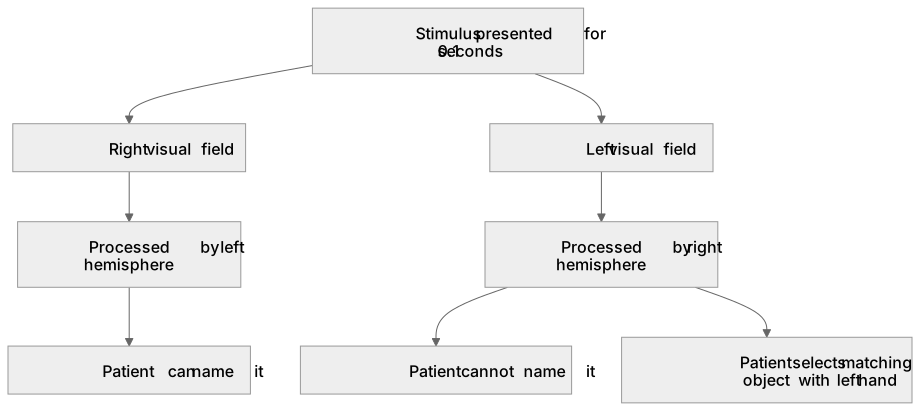
Label the diagram
Some boxes have lost their names. Pick the right name for each number.
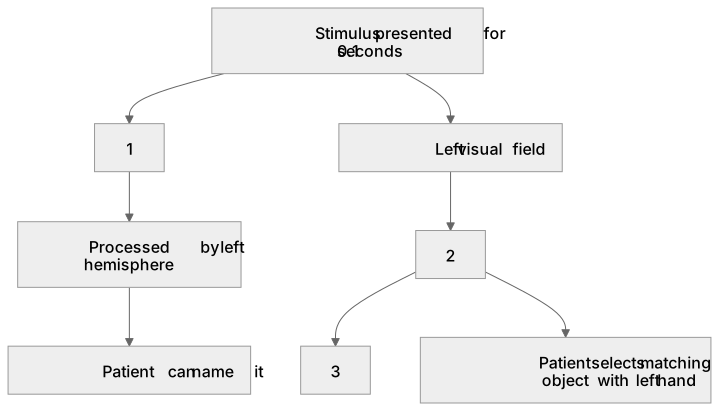
1Box 1
2Box 2
3Box 3
There is more to this lesson
The full lesson goes on to check your understanding and help you earn the marks. Create a free account to carry on, with your progress saved.
A week of Premium from your first lesson · Then the free plan continues · No card, no charge
Test your understanding of Topic 4: The brain and neuropsychology - 4.2 Studies: 4.2.2 Sperry (1968) Hemisphere Deconnection and Unity in Conscious Awareness
Active recall beats re-reading. Take an instant quiz now to test what you’ve learned and lock it into long-term memory.
A week of Premium from your first lesson · Then the free plan continues · No card, no charge